Eggless Tres Leches Cake Recipe with Yogurt
This eggless tres leches cake recipe uses a yogurt-enriched vanilla sponge that absorbs a balanced three-milk soak evenly, then finishes with lightly sweetened whipped cream. It is a moist, chilled Mexican-style cake made without eggs.
What to Expect from This Eggless Tres Leches Cake
Tres leches is defined by its light cake base, three-milk soak, thorough chilling, and creamy finish. This version uses a yogurt-based sponge rather than the whipped-egg sponge found in many traditional formulas, so it is a deliberate eggless adaptation of the Mexican-style dessert.
- The finished crumb should be saturated and tender, not wet, gummy, or collapsed.
- The cake is baked, pierced, soaked gradually, chilled, and then topped with whipped cream.
- A shallow rectangular pan gives the milk mixture more surface area to enter the crumb evenly.
Why the Ingredients Work
The sponge is built for absorption rather than for eating plain. Yogurt contributes moisture, acidity, and some binding; oil keeps the crumb supple after refrigeration; flour and cornstarch provide enough structure to hold the soak; and the two leaveners create lift without relying on eggs.
- Sweetened condensed milk contributes concentrated sweetness and body to the soak.
- Evaporated milk adds dairy richness without adding the sugar found in condensed milk.
- Whole milk keeps the soak fluid and prevents the concentrated milks from becoming too heavy.
- A small amount of cornstarch in the whipped cream helps it hold its shape without making it frosting-like.
Ingredients
- 2 cups all-purpose flour, spooned and leveled
- 1/4 cup cornstarch
- 1 tablespoon baking powder
- 1/2 teaspoon baking soda
- 3/4 teaspoon fine salt
- 1 cup granulated sugar
- 1/2 cup neutral oil, such as canola or sunflower oil
- 1 cup plain full-fat yogurt, stirred smooth
- 3/4 cup whole milk
- 2 teaspoons vanilla extract
- 1 can sweetened condensed milk, about 14 ounces or 397 grams
- 1 can evaporated milk, about 12 ounces or 354 grams
- 1/2 cup whole milk, for the soak
- 1/2 teaspoon ground cinnamon, for the soak
- 1 1/2 cups heavy whipping cream, cold
- 2 tablespoons confectioners’ sugar, sifted
- 2 teaspoons cornstarch, for stabilizing the whipped cream
- 1 teaspoon vanilla extract, for the whipped cream
The Technique for an Evenly Soaked Sponge
The most important technique is controlling the cake’s structure and the speed of the pour. Mix only until the flour disappears, bake the center fully, and allow the cake to cool until warm and set before piercing it. Deep, closely spaced holes are more useful than a few large punctures.
- Distribute holes across the center, edges, and corners; dry corners are usually a perforation problem.
- Pour in stages so the crumb has time to absorb the liquid instead of allowing it to collect on top.
- Reserve the final quarter of the soak until the cake shows that it can take more.
- Keep the cake in the pan throughout soaking and chilling for support.
Instructions
- Prepare the pan and oven: Heat the oven to 350°F (175°C). Lightly grease a 9-by-13-inch metal baking pan and line the bottom with parchment, leaving two sides overhanging for easier handling. Do not line the sides; the batter benefits from gripping the pan as it rises.
- Combine the dry ingredients: Whisk the all-purpose flour, 1/4 cup cornstarch, baking powder, baking soda, and salt in a medium bowl until evenly distributed.
- Make the eggless batter: In a large bowl, whisk the sugar, oil, yogurt, 3/4 cup whole milk, and 2 teaspoons vanilla until smooth. Add the dry mixture in two additions, folding or whisking gently just until no dry flour remains. The batter will be fairly thick; do not continue mixing once it is smooth.
- Bake the sponge: Scrape the batter into the prepared pan and spread it into an even layer, especially into the corners. Bake for 28 to 32 minutes, rotating once if needed, until the center springs back lightly and a skewer inserted in the middle comes out with a few moist crumbs but no wet batter.
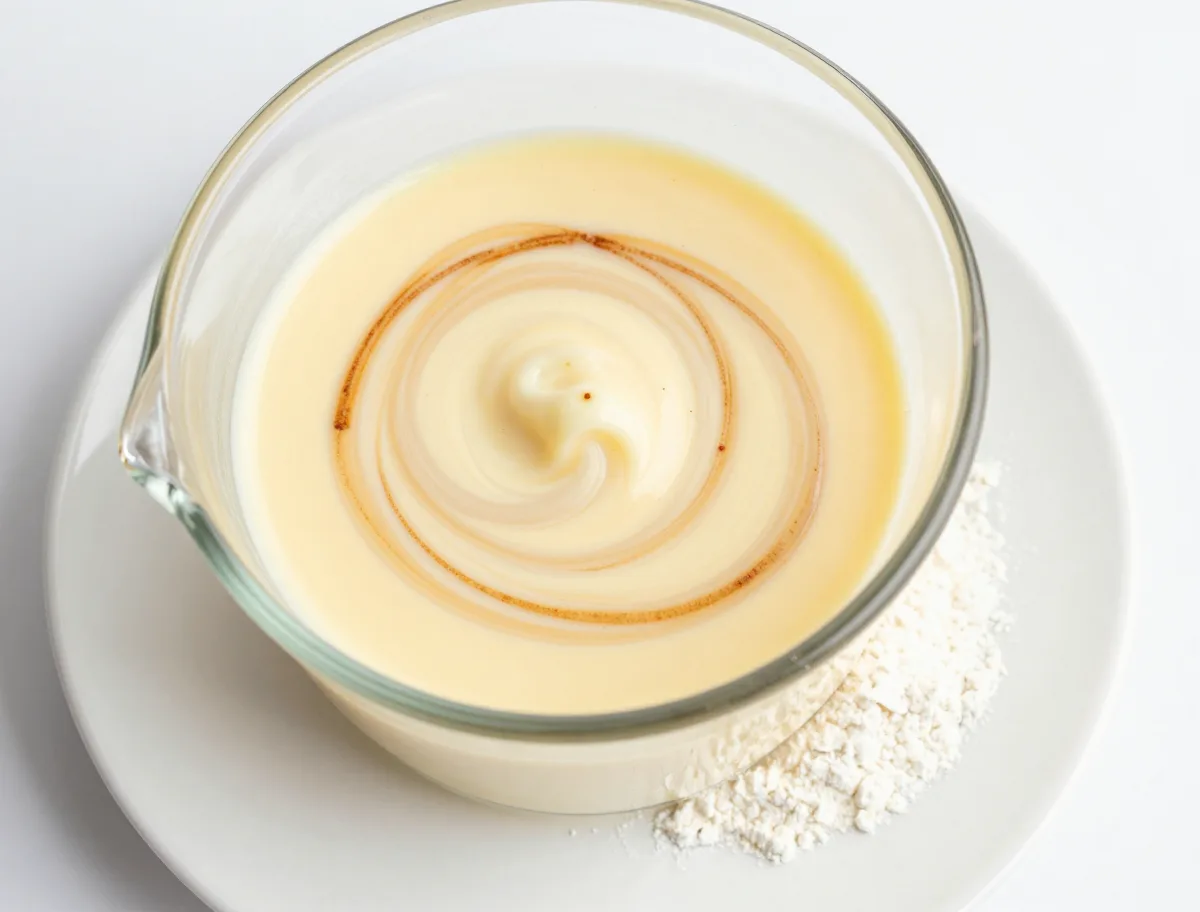
- Mix the three-milk soak: While the cake bakes, whisk the sweetened condensed milk, evaporated milk, 1/2 cup whole milk, and cinnamon in a large measuring jug until smooth. Set aside at room temperature. The mixture should be pourable rather than cold and thick.
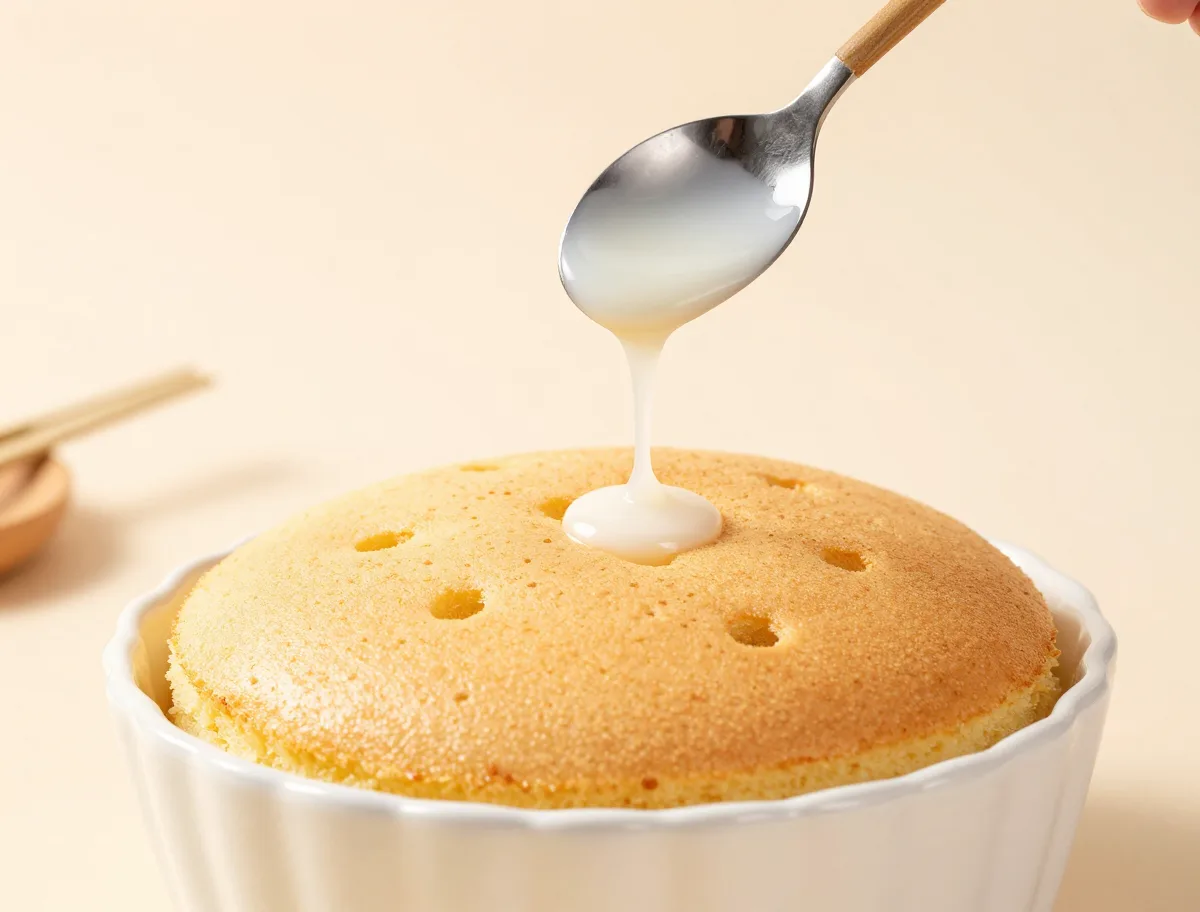
- Pierce and soak the cake: Let the baked cake cool in its pan for 20 to 25 minutes, until warm rather than hot and firm enough to handle. Using a skewer, make holes about 1 inch apart across the entire surface, reaching nearly to the bottom and paying particular attention to the corners. Pour about three-quarters of the milk mixture over the cake in several passes, pausing as it absorbs. Add the remainder only where the surface still looks dry; a small amount of liquid at the edges is acceptable, but the cake should not be submerged.
- Chill until set: Cover the pan and refrigerate for at least 4 hours, preferably overnight. The cake is ready for topping when the surface is evenly moist and glossy, the center feels chilled and slightly yielding, and no large puddles remain.
- Whip the topping: For the topping, whisk the 2 teaspoons cornstarch and confectioners’ sugar together. Using a chilled bowl and beaters, whip the cold heavy cream and 1 teaspoon vanilla on medium speed until it begins to thicken. Add the sugar-cornstarch mixture and continue whipping just until smooth, stable medium-firm peaks form. Stop before the cream looks grainy.
- Finish and serve: Spread the whipped cream over the fully chilled cake. Dust lightly with additional cinnamon only if desired, then cut with a serrated knife, wiping the blade between slices. Serve cold.
How to Tell When the Cake Is Ready
An eggless cake intended for a substantial soak must be fully baked even though its final texture will be very moist. Before soaking, look for a lightly springy center and moist crumbs on the tester. After chilling, the crumb should yield under a knife but remain cohesive enough to serve in a clean portion.
- Wet batter on a tester means the cake needs more baking time; it is not ready to soak.
- A glossy surface after soaking is normal, but deep pools or sloshing liquid indicate that the cake has reached its capacity.
- A properly chilled slice has no dry center, gummy band, or loose collapse.
- The whipped cream should hold a defined ridge when spread.
- The baked center springs back lightly when pressed.
- A skewer shows moist crumbs, not liquid batter.
- After soaking, the cake looks moist and glossy but is not floating in milk.
- After chilling, a slice holds its shape while remaining soft and creamy.
- The whipped cream forms smooth medium-firm peaks and does not look grainy.
The Variables That Matter Most
Removing eggs removes both aeration and heat-set protein structure, so this sponge uses yogurt, starch, flour, and measured chemical leavening together. More leavener is not a shortcut to a lighter cake: excessive gas can make the center rise quickly and then fall under the weight of the soak.
- Yogurt provides the acidity needed for the baking soda, while baking powder supplies additional balanced lift.
- Overmixing develops gluten and can produce a tight, tough crumb that absorbs unevenly.
- Oil remains soft when chilled, which is useful in a refrigerated dessert; butter-based cakes can firm more noticeably.
- The amount absorbed depends on crumb porosity, hole depth, pan dimensions, and how quickly the liquid is added.
Egg substitutes can provide different structural, binding, moisture, and leavening functions; King Arthur Baking’s guide to substituting eggs explains why an eggless sponge needs a coordinated formulation rather than simply omitting eggs.
Common Eggless Tres Leches Cake Problems
Most failures happen before the topping is added. Accurate measuring, a fully baked sponge, and a gradual pour solve more problems than changing the milk mixture after the fact.
- Dense cake: Expired leaveners, overmixing, or an unusually wet yogurt can be responsible. Mix gently and check that the baking powder and soda are fresh.
- Gummy center or collapse: This usually points to underbaking, excess liquid, or too much leavener. A soaked underbaked cake cannot be reliably repaired by removing some milk.
- Dry patches: Add deeper, more evenly spaced holes and direct the soak toward edges and corners. Apply reserved liquid only to areas that remain dry.
- Pooling milk: Stop pouring, tilt the pan slightly to redistribute liquid, and refrigerate. Do not force in the reserved soak if the surface remains saturated.
- Overly sweet flavor: Use unsweetened dairy as specified and keep the whipped cream lightly sweetened. Cinnamon and a small amount of salt in the cake help provide contrast.
- Broken whipped cream: Warm cream, overwhipping, or under-stabilizing can cause slumping. Chill the bowl and stop beating as soon as stable peaks form.
Useful Substitutions and What They Change
Substitutions are possible, but they should preserve the ingredient’s function rather than simply match its volume. Expect changes in sweetness, richness, thickness, or absorption whenever a concentrated dairy product is replaced.
- No evaporated milk: Use an equal amount of whole milk for a thinner, less concentrated soak. For a closer approximation, gently reduce 1 1/2 cups whole milk to about 1 cup, cool it completely, and then use it.
- No yogurt: Cultured buttermilk can replace it in the same amount, although batter thickness may vary. Sour cream thinned with a little of the listed milk is another option but produces a richer crumb.
- Cake flour: Replace the all-purpose flour by weight for a more delicate cake, but handle the batter gently because the sponge will have less structural margin.
- Gluten-free: Use a tested all-purpose gluten-free baking blend that contains a binder, and expect a somewhat different absorption rate.
- Dairy-free: Use plant-based yogurt, plant-based milk, sweetened condensed coconut milk, and a compatible plant-based whipping cream as a coordinated adaptation rather than replacing only one dairy ingredient.
Flavor Variations That Still Read as Tres Leches
The core identity is the tender cake, three-part milk soak, chilling, and cream finish. Small flavor changes can be made without turning the dessert into a different milk cake.
- For a stronger vanilla profile, add finely grated vanilla bean seeds to the soak or topping.
- Add 1 teaspoon finely grated orange zest to the batter for a citrus accent.
- Replace the cinnamon in the soak with 1 teaspoon instant espresso powder for a coffee version.
- Finish with toasted unsweetened coconut or a few dry berries immediately before serving.
- Dense cooked milk cakes, cardamom-forward Indian milk cakes, and syrup-soaked cakes are related desserts but are not the same preparation.
How to Serve Eggless Tres Leches Cake
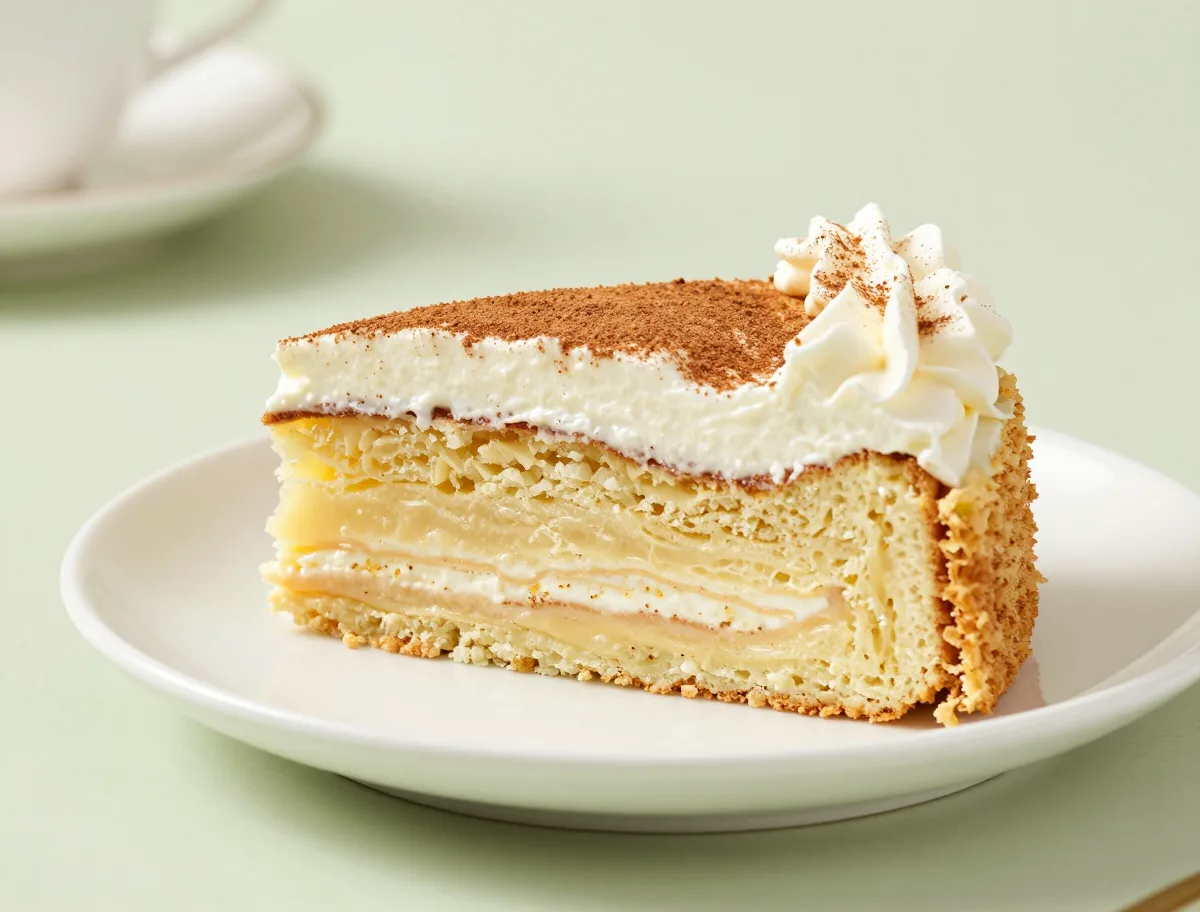
Serve this cake cold, when the milk has fully distributed and the crumb is firm enough to cut. The restrained whipped cream keeps the dessert from becoming overly sweet, while a dry garnish adds contrast without introducing extra liquid.
- Cut modest portions with a serrated knife and wipe the blade between slices.
- A light cinnamon dusting, toasted coconut, or a few berries makes a suitable finish.
- Serve with unsweetened coffee, black tea, or another lightly bitter drink.
- Keep the cake refrigerated until shortly before serving rather than allowing it to warm extensively.
How to Store, Freeze, and Transport the Cake
Tres leches is an excellent make-ahead dessert. The soaked cake can be refrigerated overnight, and the whipped cream can be added later for the cleanest appearance.
- Cover and refrigerate the finished cake at 40°F (4°C) or below.
- For best quality, eat it within 3 to 4 days; the crumb will gradually become softer.
- For freezing, wrap the baked, unsoaked sponge airtight for up to 1 month. Thaw it covered in the refrigerator, then soak and top it fresh.
- Freezing the fully soaked and topped cake is possible but may cause weeping cream and a softer, less uniform crumb.
- Transport the cake in an insulated carrier with cold sources and return it to refrigeration promptly.
- Do not reheat tres leches cake.
Eggless Tres Leches Cake FAQ
These answers address the practical questions that most affect the sponge, soak, sweetness, and final texture.
How does this tres leches cake work without eggs?
The formulation replaces the functions of eggs with yogurt for moisture and binding, cornstarch for tenderness, and controlled baking powder and baking soda for lift. It is not a simple egg-based recipe with the eggs omitted.
Can I use yogurt as a direct substitute in any tres leches recipe?
Not reliably. Yogurt changes the liquid balance and acidity, so the flour and leaveners must be formulated around it. Use the tested proportions in this recipe rather than adding yogurt to an egg-based formula.
How much of the milk mixture should I pour?
This recipe provides a target amount, but absorption is the better guide. Pour about three-quarters first, wait briefly, and add the rest only where the cake still looks dry. The finished cake should be saturated but not floating.
Can I make tres leches without evaporated milk?
Yes. Replace it with whole milk for a thinner, less concentrated soak, or reduce whole milk gently before cooling it and using it as a closer approximation. Do not replace evaporated milk with additional sweetened condensed milk because the cake will become excessively sweet.
Is this cake too sweet?
Condensed milk supplies substantial sweetness, so the other dairy ingredients are unsweetened and the whipped cream contains only a modest amount of sugar. For additional balance, serve it very cold and use cinnamon or unsweetened coffee alongside it.
How long does tres leches cake need to chill?
Four hours is the minimum practical chilling time, but overnight refrigeration gives the most even absorption and cleanest slices.
Why did my cake become gummy or sink after soaking?
The most likely causes are an underbaked center, excess yogurt or liquid, too much leavener, or cutting before the cake was cold. A fully set sponge and gradual soaking are essential; a visibly underbaked cake cannot be reliably rescued after soaking.
Is this a vegetarian tres leches cake?
The recipe is egg-free and dairy-based, so it is generally vegetarian. It is not vegan or dairy-free. Check packaged ingredients if your dietary standard excludes particular stabilizers or processing aids.
Is this the same as an Indian eggless milk cake?
No. This is a Mexican-style tres leches adaptation: a baked sponge pierced and saturated with three milks. Indian milk cakes often use different ingredients, cooking methods, spices, and a denser texture.
A Note on Mexican-Style Tres Leches
Tres leches is a Latin American celebration cake strongly associated with Mexico and also with Nicaragua and other parts of the region. Its exact birthplace is disputed, and the spread of canned evaporated and condensed milk helped popularize the modern format.
- Traditional versions commonly use an egg-containing sponge, then add the milk soak and a cream or meringue topping.
- This yogurt-based eggless sponge is a contemporary adaptation of the Mexican-style format, not a claim that the historical standard was egg-free.
- The defining method is the milk-soaked, chilled cake rather than one universally fixed milk ratio.
Food-Safety Guidance for a Dairy-Rich Cake
The milk soak, yogurt-based sponge, and whipped cream make this a perishable dessert. Keep it covered and cold throughout storage and transport. For additional official guidance, see the FDA’s food-storage guidance.
- Refrigerate the cake at 40°F (4°C) or below.
- Do not leave it at room temperature for more than 2 hours, or more than 1 hour when the temperature is above 90°F (32°C).
- Use pasteurized dairy products and clean utensils when serving.
- Discard the cake if it has remained above safe refrigeration temperatures for too long; smell and appearance are not dependable safety tests.
- Return leftovers to the refrigerator promptly after serving.