Betty Crocker Chicken Pot Pie Recipe: Classic Double-Crust
This classic Betty Crocker chicken pot pie recipe pairs cooked chicken, peas and carrots, and a creamy homemade gravy with a flaky refrigerated double crust and golden-brown finish.
What Makes This a Classic Chicken Pot Pie
This is the baked American-style version: a creamy, roux-thickened chicken filling enclosed by both a bottom and a top pastry crust. The finished pie should combine a crisp, flaky exterior with a savory filling that is thick enough to spoon cleanly after resting.
- The defining ingredients are cooked chicken or turkey, peas and carrots, onion, broth, milk, and refrigerated pastry.
- The filling is a creamy gravy, not a loose soup.
- The traditional finish is a fully baked, golden-brown double crust with steam vents.
Why the Ingredients Work
The filling depends on a simple balance of butter, flour, broth, and milk. Butter carries the onion’s flavor and coats the flour; flour gives the sauce enough body to remain inside the crust; broth supplies savoriness; and milk rounds out the texture without making the filling heavy.
- Cooked bite-size poultry distributes more evenly than large pieces and stays tender in the sauce.
- Frozen peas and carrots are convenient and appropriately sized for the short bake; draining them prevents excess water.
- Refrigerated crusts provide the classic flaky, practical double-crust format while keeping the preparation manageable.
Ingredients
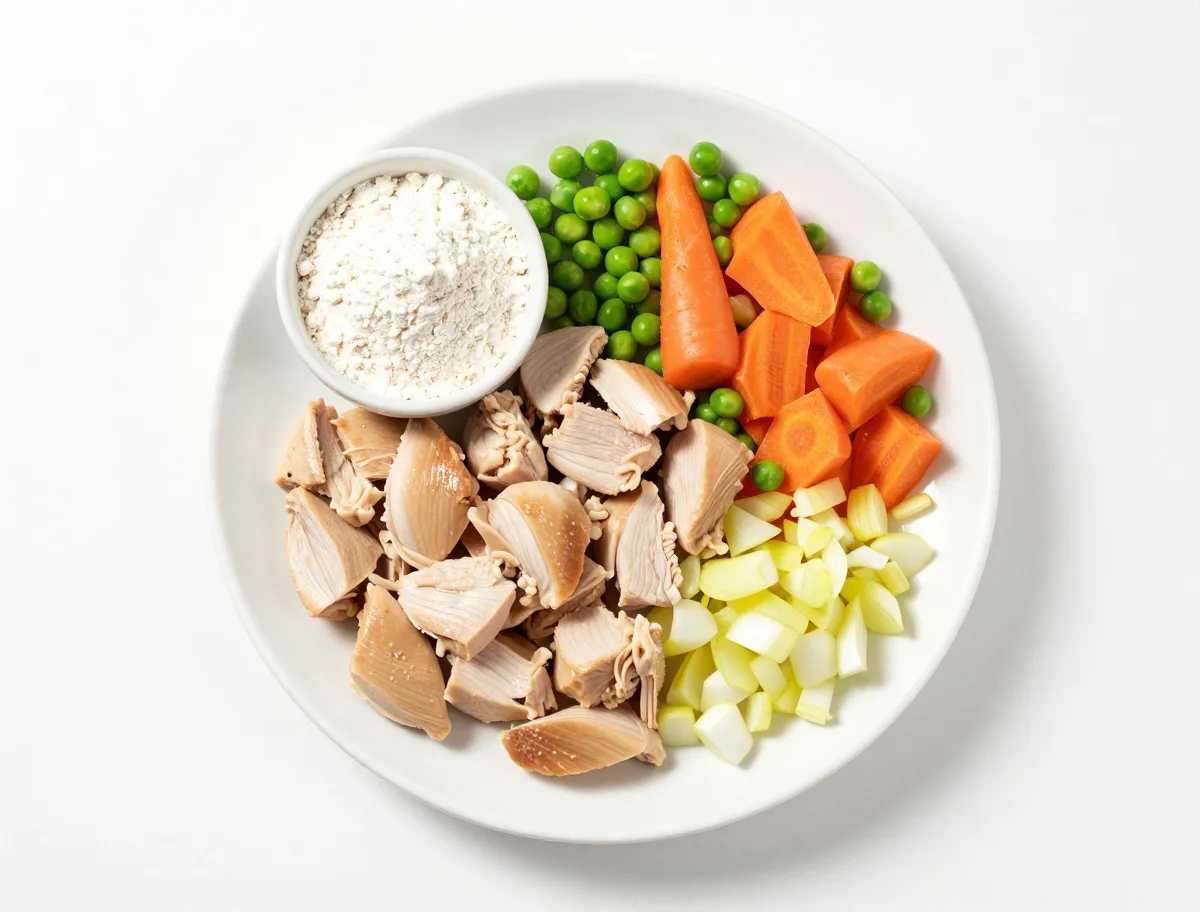
- 1 package refrigerated pie crusts, a two-crust package, softened according to package directions
- 1/3 cup unsalted butter
- 1/3 cup yellow onion, finely chopped
- 1/3 cup all-purpose flour
- 1/2 teaspoon fine salt, plus more if needed
- 1/4 teaspoon ground black pepper
- 1 3/4 cups chicken broth
- 2/3 cup milk
- 2 1/2 to 3 cups cooked chicken or turkey, boneless, cut into bite-size pieces
- 1 (10-ounce) package frozen peas and carrots, thawed and thoroughly drained
How to Assemble the Double-Crust Chicken Pot Pie
The most important sequence is to finish the sauce before adding the solids, then fit the pastry gently rather than stretching it. The sauce should be visibly thick before it goes into the crust, and the top must be vented so steam can escape without forcing open the sealed rim.
- Cook the butter-and-flour mixture until bubbly but still pale; a deeply browned roux will not thicken as effectively.
- Ease the bottom crust into the dish and leave enough pastry around the edge to create a firm seal.
- Use a baking sheet beneath the dish to catch any bubbling filling or butter.
- If the pastry warms and feels greasy or floppy, chill it briefly before rolling or sealing.
Instructions
- Prepare the oven and vegetables: Heat the oven to 425°F (220°C). Set a 9-inch, 2-quart glass baking dish on a parchment-lined baking sheet. Make sure the thawed peas and carrots are well drained so excess water does not loosen the filling.
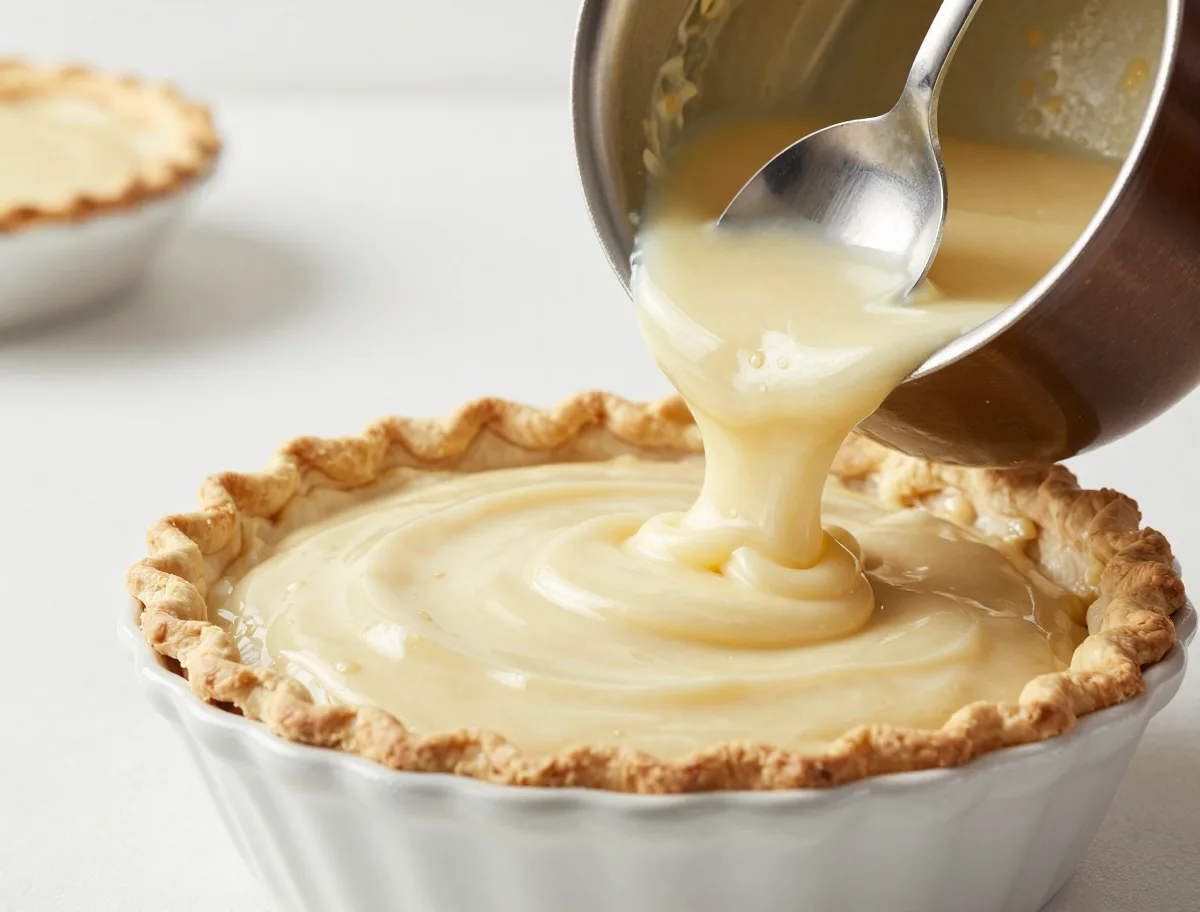
- Make the creamy filling: Melt the butter in a large saucepan over medium heat. Add the onion, flour, salt, and pepper. Cook, stirring, until the mixture is smooth and bubbling, about 2 minutes. Gradually whisk in the broth and milk. Bring to a full boil, stirring constantly, then continue stirring for 1 minute; the sauce should be smooth and thick enough to coat a spoon.
- Add the chicken and vegetables: Remove the saucepan from the heat and fold in the cooked chicken and drained peas and carrots. Let the mixture stand for about 10 minutes, until it is hot but no longer vigorously steaming. Taste and adjust the salt only if needed.
- Fit the bottom crust: Unroll one crust and ease it into the baking dish, fitting it into the corners or curve without stretching it. Leave enough overhang to seal the top crust. If the pastry has become soft, chill it briefly before continuing.
- Fill and cover the pie: Spoon the chicken mixture into the crust and spread it evenly without packing it down. Cover with the second crust. Trim excess pastry if necessary, turn the edge under, and press firmly to seal. Crimp the rim, then cut several vents in the center of the top crust.
- Bake until golden and bubbling: Bake on the prepared baking sheet at 425°F (220°C) for about 35 minutes. If the rim becomes deeply browned before the center is bubbling, shield just the edge with foil. The pie is ready when the crust is golden throughout and gravy bubbles through the vents or at the center.
- Rest before serving: Transfer the pie to a cooling rack and let it rest for 15 minutes before slicing. This gives the sauce time to settle so the portions are creamy rather than runny.
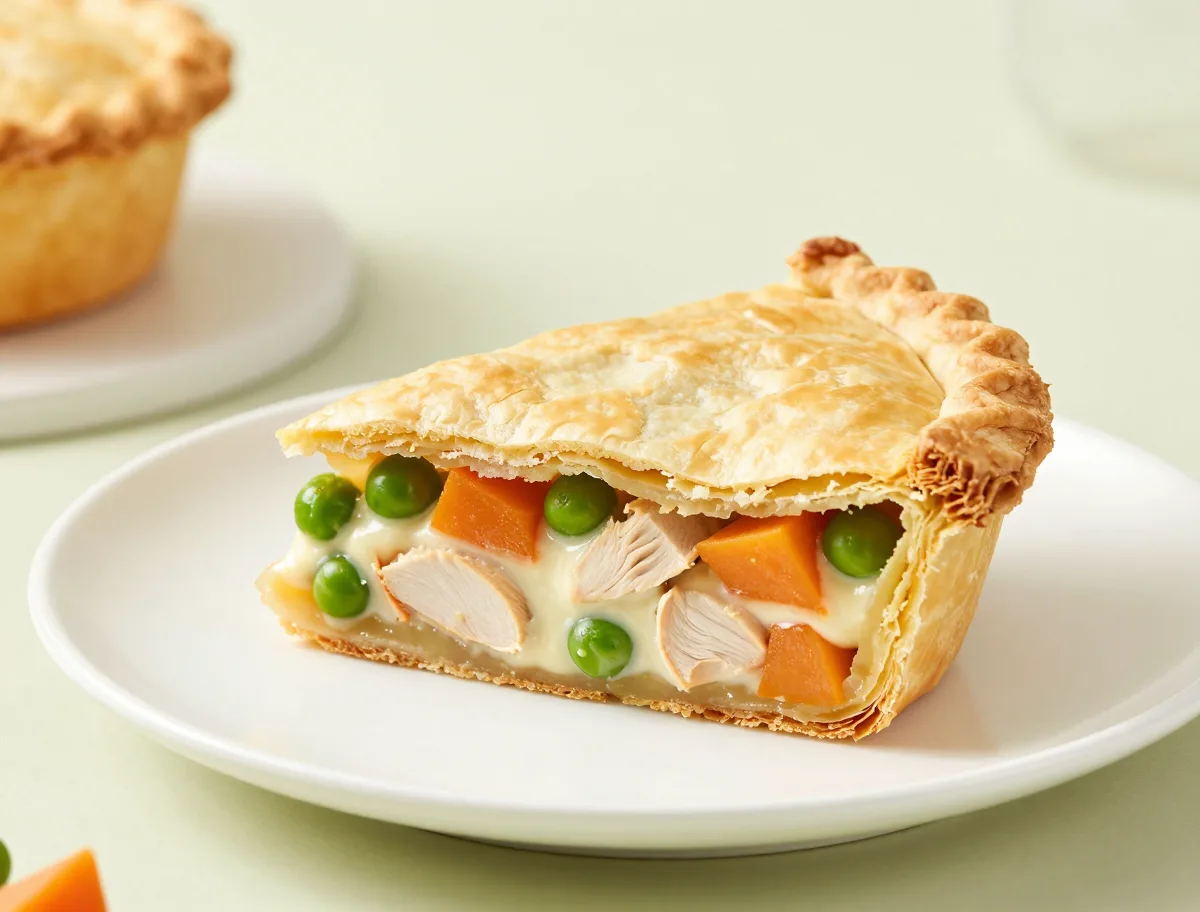
How to Tell When Chicken Pot Pie Is Done
Time is a useful guide, but several signals should agree before the pie comes out of the oven. The top should be browned, the center should be visibly bubbling, and the pastry at the rim and bottom should look baked rather than soft or pale.
- A sauce that coats a spoon before baking is the right starting consistency.
- Bubbling through the center vents is more meaningful than browning at the edge alone.
- Rest the pie before cutting; the filling thickens as it cools slightly.
- For reheated pie, verify 165°F (74°C) in the thickest part of the filling.
Additional Doneness Cues
- The sauce coats a spoon before the chicken and vegetables are added.
- The top crust is golden brown, including the areas near the vents.
- The filling bubbles in the center, not only around the outer edge.
- The bottom pastry looks baked rather than pale or doughy.
- For reheated leftovers, the center should reach 165°F (74°C).
The Cooking Details That Matter Most
Flour thickens only after the liquid reaches a proper simmer or boil, which is why the sauce needs a brief boil before the chicken and vegetables are stirred in. Pastry quality depends on the opposite principle: keep it cool and handle it as little as possible so its layers remain distinct.
- A short boil activates the flour and prevents a sauce that thins after baking.
- Warm, watery vegetables can dilute the filling and soften the bottom crust, so thawed vegetables should be drained.
- A fully preheated oven gives the pastry a faster start and helps set the crust before it absorbs too much moisture.
- Protect the rim with foil rather than lowering the oven temperature when the center still needs baking.
Common Chicken Pot Pie Problems and Fixes
Most disappointing pies can be traced to a loose sauce, excess moisture, poor pastry handling, or stopping when only the top edge looks done. Prevention is easier than repair, so judge the filling before assembly and the center of the pie during baking.
- Runny filling: The sauce may not have boiled long enough, or the vegetables may have released water. Return the sauce to the heat and cook it until it coats a spoon before assembling.
- Soggy bottom: Drain the vegetables, avoid a violently steaming filling, bake on the lower-middle rack, and make sure the oven is fully hot. A severely soggy crust cannot be completely restored after baking.
- Cracked or leaking crust: The pastry may have been stretched, overfilled, or inadequately sealed. Patch small cracks with pastry scraps and press the rim firmly.
- Brown top with a cool center: Cover the top loosely with foil and continue baking until the filling bubbles in the middle.
- Pale bottom crust: Continue baking rather than relying on the browned rim as the only doneness cue.
Chicken, Turkey and Vegetable Substitutions
The recipe is particularly adaptable because it was designed around cooked poultry and convenient vegetables. Substitutions work best when they preserve the original volume and do not introduce extra liquid.
- Cooked turkey can replace chicken in the same general quantity; it is especially useful for holiday leftovers.
- Roast, poached, or rotisserie chicken is suitable once deboned and cut into bite-size pieces. Adjust salt if the chicken is already seasoned.
- Fresh carrots and peas can replace frozen vegetables. Dice the carrots small and blanch or steam them until partly tender; add fresh peas near the end of cooking.
- A thawed, drained mixed-vegetable blend can replace peas and carrots, although corn or green beans will move the flavor slightly away from the classic profile.
- Homemade pastry can replace refrigerated crusts, provided there is enough chilled dough for both a bottom and a top crust.
Which Pot Pie Variations Still Fit the Classic Style
Chicken-to-turkey pot pie remains within the classic style because it preserves the creamy roux-based filling and double pastry crust. Biscuit, Bisquick, crescent, cornbread, puff-pastry, and condensed-soup versions are legitimate pot pie variations, but they are different recipes with different textures and baking behavior.
- Keep both pastry crusts and the homemade flour-thickened sauce when the goal is the classic Betty Crocker profile.
- A single top crust changes the pastry-to-filling balance and should not use the same timing automatically.
- Topping-based shortcut recipes are easier in some cases, but they are not substitutes for this refrigerated double-crust method.
How to Store, Freeze and Reheat Chicken Pot Pie
For the best crust, make the filling ahead rather than holding a fully assembled unbaked pie. Cool the filling promptly in a shallow container, refrigerate it, and assemble with chilled pastry when ready to bake.
- Refrigerate cooked filling or baked leftovers within 2 hours, or within 1 hour when the room temperature is above 90°F (32°C).
- Use refrigerated leftovers within 3 to 4 days when held at 40°F (4°C) or below.
- Freeze baked portions or a fully cooled pie in airtight wrapping for best quality within about 2 to 3 months. The crust may soften slightly after thawing.
- Reheat refrigerated portions in a 350°F (175°C) oven until the center reaches 165°F (74°C); cover the crust if it browns too quickly.
- Microwaving is convenient but softens the pastry, so use the oven when crust texture matters.
Classic Betty Crocker Chicken Pot Pie FAQ
These answers distinguish the classic double-crust recipe from Betty Crocker’s easier topping-based variations and clarify the practical choices that most affect the finished pie.
Is this the official Betty Crocker chicken pot pie recipe?
It is an independently worded recipe based on the classic Betty Crocker formula and method: a butter-and-flour sauce, cooked chicken or turkey, frozen peas and carrots, two refrigerated crusts, and a 425°F bake. Refer to the official Betty Crocker classic chicken pot pie recipe for the publisher’s current version.
What kind of crust does the classic recipe use?
It uses two refrigerated pie crusts—one for the bottom and one for the top. This is a rolled double-crust pie, not a biscuit, Bisquick, crescent, or puff-pastry topping.
What pan should I use?
A 9-inch, 2-quart glass baking dish is the traditional specification. A similarly sized round pie plate also works, but the crusts must be rolled and trimmed to match its shape and depth.
What temperature and bake time should I use?
Bake at 425°F (220°C) for about 35 minutes. Treat that time as an estimate: the pie is ready when the crust is golden and the filling bubbles in the center.
Can I use leftover chicken or turkey?
Yes. The recipe is designed for 2 1/2 to 3 cups of cooked chicken or turkey. Cut it into bite-size pieces and adjust the salt if the poultry is already strongly seasoned.
Can I use fresh peas and carrots instead of frozen?
Yes, but prepare them first. Dice carrots small and partially cook them; fresh peas need only brief cooking. Drain all vegetables well so they do not thin the sauce.
How do I keep the bottom crust from getting soggy?
Make sure the sauce is thick before assembly, drain the vegetables, avoid filling the crust while the mixture is violently steaming, and bake in a thoroughly preheated oven on a baking sheet. A hot metal pan or optional partial blind-bake can help in difficult cases, but neither is part of the simplest classic method.
Why should the pie rest before slicing?
The gravy is at its loosest when the pie first leaves the oven. A 15-minute rest lets the flour-thickened sauce settle, producing fuller, less runny portions.
Can I make the pie ahead?
Yes. For the best pastry, prepare and refrigerate the filling promptly, then assemble and bake it with chilled crusts. Baked leftovers can be refrigerated for 3 to 4 days or frozen for best quality for about 2 to 3 months.
The American Tradition Behind This Pot Pie
Chicken pot pie belongs to a broad meat-pie tradition with both European and American roots. The Betty Crocker version represents a familiar American home-cooking form built around cooked poultry, gravy, vegetables, and pastry; it should be understood as a classic branded recipe tradition rather than the invention of the dish itself.
- American chicken pie recipes were documented well before the modern Betty Crocker era.
- The phrase pot pie has regional meanings; some Pennsylvania Dutch versions are broth-and-noodle dishes without a baked crust.
- This recipe specifically refers to the oven-baked, creamy, double-crust American style.
Food-Safety Notes for Chicken Pot Pie
A golden crust does not by itself prove that the poultry-filled center is hot enough. Handle cooked chicken, dairy, and the finished pie as perishable foods, and use a thermometer when reheating or whenever the center is uncertain.
- If cooking poultry specifically for this recipe, bring it to 165°F (74°C) before using it in the filling.
- Refrigerate filling and leftovers within 2 hours, or within 1 hour in temperatures above 90°F (32°C).
- Keep refrigerated leftovers at 40°F (4°C) or below and use them within 3 to 4 days.
- Reheat leftovers until the thickest central portion reaches 165°F (74°C), inserting the thermometer without touching the dish. See the USDA safe cooking temperature guidance for the poultry and reheating standard.
- Prevent cross-contamination by washing hands and separating utensils and cutting boards used for raw poultry from those used for cooked ingredients.
Recipe Notes
- The classic format uses two refrigerated pastry crusts and a flour-thickened broth-and-milk sauce rather than canned soup or a biscuit topping.
- Use cooked chicken or turkey from leftovers, poached chicken, roast chicken, or a deboned rotisserie chicken.
- A short cooling period for the filling helps protect the bottom crust, although the traditional method begins assembly while the filling is still warm.
- A round pie plate can be used, but roll and trim the crusts to fit its shape rather than following square-dish dimensions.