Buffalo Chicken Dip Recipe With Rotisserie Chicken
This buffalo chicken dip recipe with rotisserie chicken combines tender shredded chicken, buffalo sauce, cream cheese, ranch, and melty cheddar-Jack for a hot, creamy, oven-baked appetizer.
What Makes This Rotisserie Buffalo Chicken Dip Work
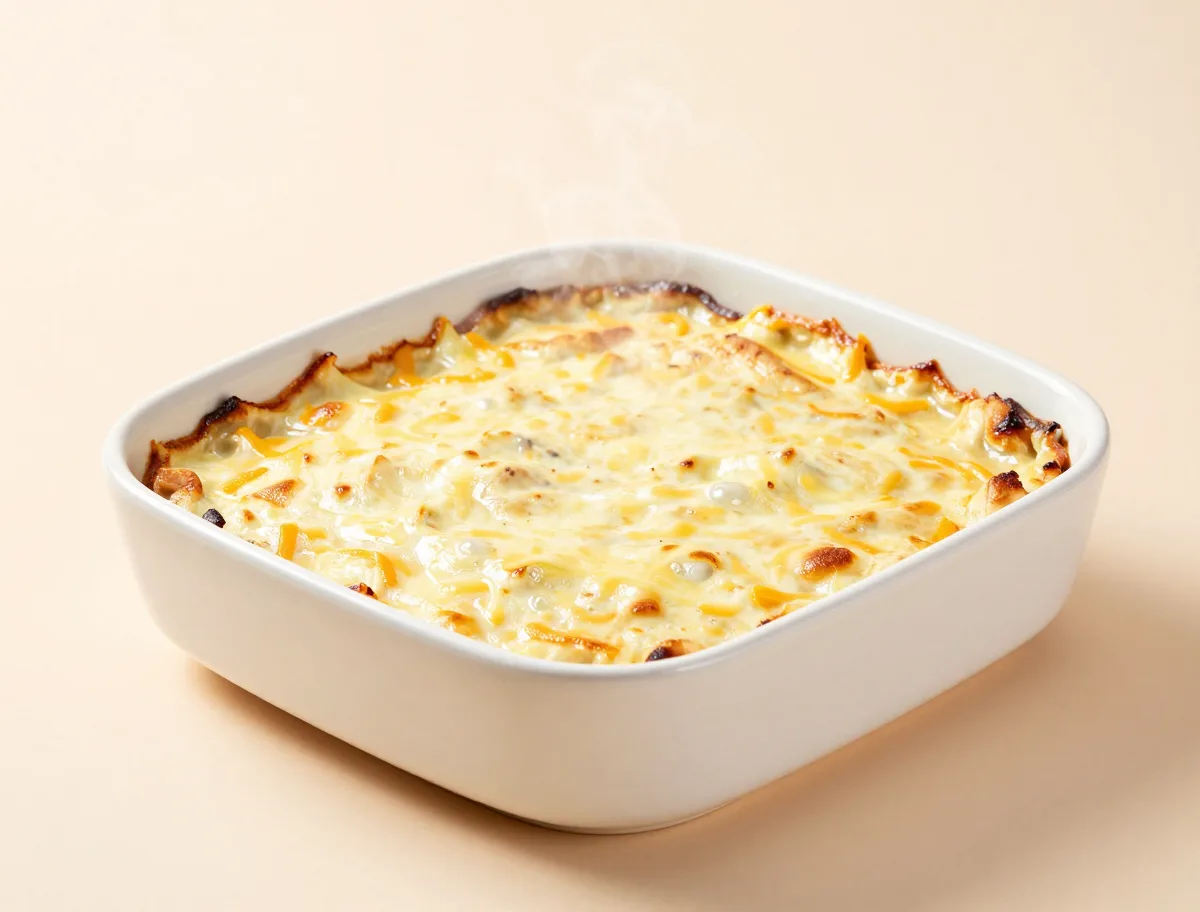
This is a hot, scoopable party dip with tender chicken suspended in a smooth, tangy buffalo-cream base. The cheddar-Jack topping melts into a lightly browned cap while the interior stays creamy rather than pasty or oily.
- The chicken should remain in bite-size shreds instead of being pulverized into the base.
- Moderate heat and a shallow dish help the center warm before the topping overbrowns.
- The finished dip is best served warm, when it clings to chips and sturdy vegetable dippers.
Why the Ingredients Matter
Rotisserie chicken brings ready-to-use roasted flavor and benefits from the moisture of the creamy sauce. Cream cheese supplies the body, buffalo sauce contributes acidity and cayenne heat, and ranch rounds out the mixture with herbs and tang. A young melting cheese gives the dip a smooth finish; blue cheese, when included, adds a sharper accent.
- Using both light and dark chicken meat helps prevent a dry, breast-meat-heavy dip.
- Full-fat cream cheese is the most stable choice for a rich, cohesive texture.
- Freshly shredded cheese generally melts more evenly, although pre-shredded cheese is convenient.
Ingredients
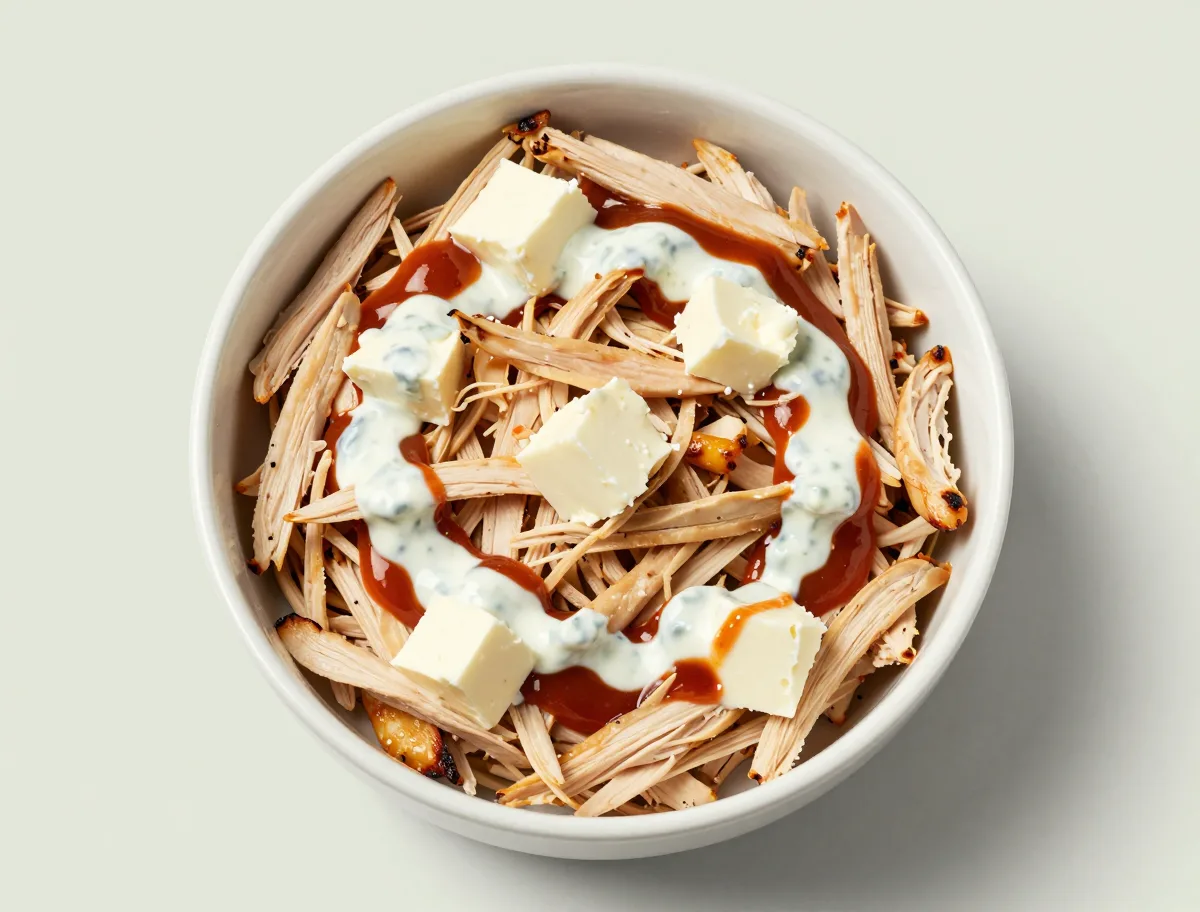
- 2 1/2 cups cooked rotisserie chicken, skin and bones removed, shredded into bite-size strands
- 8 ounces full-fat cream cheese, softened and cut into chunks
- 1/2 cup buffalo wing sauce
- 1/3 cup ranch dressing
- 1 1/2 cups cheddar-Jack cheese, shredded; 1 cup for the mixture and 1/2 cup for the top
- 2 tablespoons blue cheese crumbles, plus more for garnish if desired (optional)
- 2 tablespoons scallions, thinly sliced, for garnish (optional)
Key Technique for a Smooth, Even Dip
The order of mixing matters more than elaborate preparation. Cream cheese should be genuinely soft before it meets the acidic sauce and dressing; once that base is smooth, the chicken and cheese can be folded in without leaving dense cream-cheese pockets or unevenly seasoned bites.
- Shred the chicken into short, manageable strands; very long fibers make scooping awkward.
- Mix the sauce, dressing, and cream cheese completely before adding the solids.
- Reserve some cheese for the surface so the interior stays creamy and the topping melts evenly.
- Use a shallow 1 1/2-quart dish rather than a deep, narrow casserole.
Instructions
- Heat the oven: Position a rack in the middle of the oven and heat the oven to 350°F (175°C). Lightly grease a 1 1/2-quart shallow baking dish.
- Smooth the creamy base: Place the softened cream cheese in a large bowl. Add the buffalo sauce and ranch dressing, then stir until smooth and evenly blended. If the cream cheese is still firm, microwave it in 10-second bursts, stirring between bursts, until easily mixed; do not heat it until hot.
- Add the chicken and cheese: Fold in the shredded rotisserie chicken, 1 cup of the cheddar-Jack, and the blue cheese crumbles, if using. Mix until the chicken is thoroughly coated but still visibly textured. Taste the mixture before baking; the sauce and cheeses usually provide enough salt, while a milder or hotter buffalo sauce can be adjusted at this stage if needed.
- Fill and top the dish: Spread the mixture into the prepared baking dish and smooth the surface. Sprinkle the remaining 1/2 cup cheddar-Jack evenly over the top.
- Bake until hot and bubbling: Bake uncovered for 20 to 25 minutes, until the cheese is fully melted, the edges are gently bubbling, and the center is hot. If you want more color, broil for 30 to 60 seconds at the end, watching closely so the topping does not dry out.
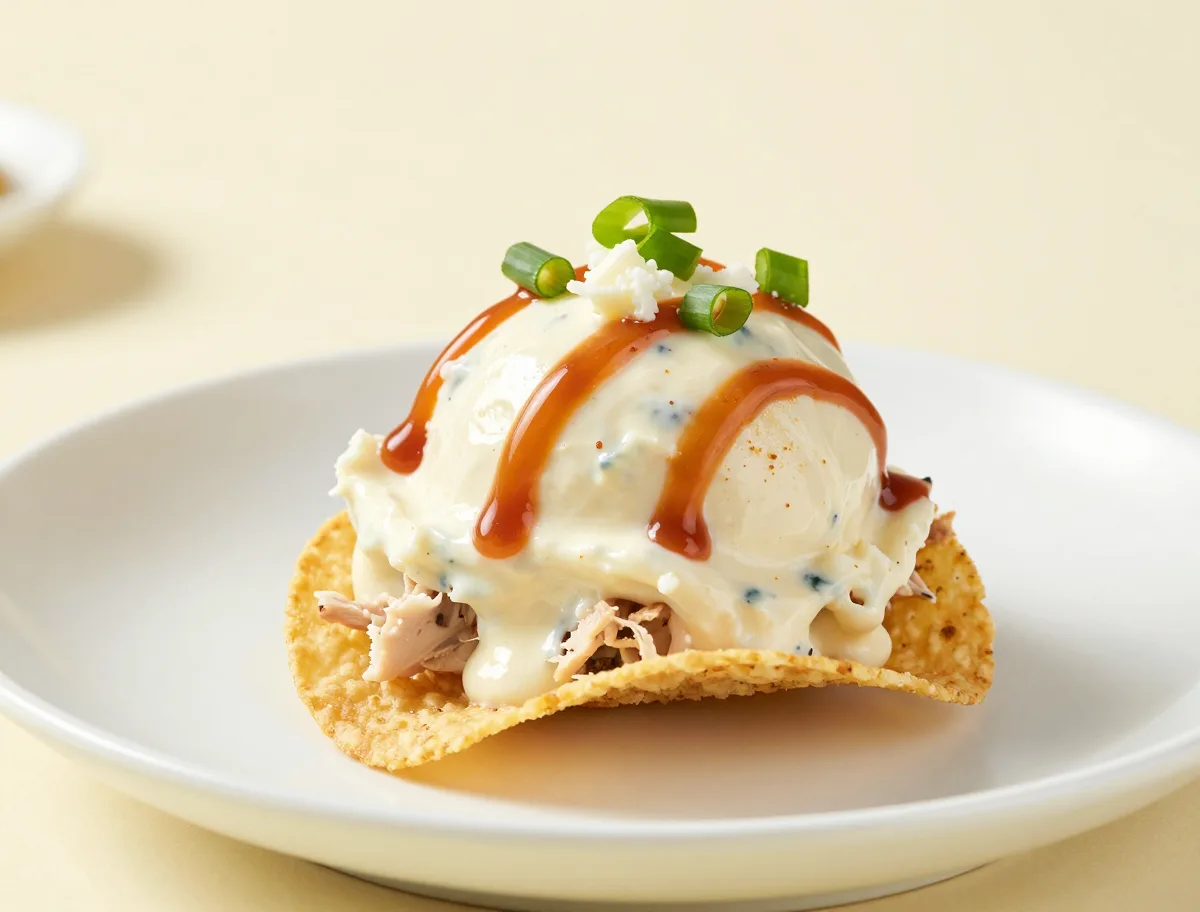
- Rest and garnish: Let the dip rest for 5 minutes so it thickens slightly, then scatter the sliced scallions and additional blue cheese crumbles over the top if desired. Serve warm.
How to Tell When Buffalo Chicken Dip Is Ready
Because the chicken is already cooked, baking is primarily about warming the center and bringing the dairy together. Look for gentle bubbling at the edges, a fully melted top, and a center that feels hot when tested with a spoon or thermometer. The dip should mound slightly on a chip but remain easy to scoop.
- Do not use deep browning as the main doneness test; the top can color before the center heats through.
- A five-minute rest helps the dip settle and prevents an overly loose first serving.
- If a small amount of surface fat appears, stir it back in gently; extensive oil separation usually signals overheating.
Doneness Cues
- The topping is completely melted and the perimeter of the dip bubbles gently.
- The center is hot and creamy rather than cool or stiff.
- The chicken remains in distinct tender shreds, and no watery liquid pools beneath the mixture.
- A brief rest makes the first scoop cohesive without making the dip firm.
How to Keep the Dip Creamy
The sauce and dressing contain water, while the cream cheese and shredded cheese contain concentrated dairy fat and proteins. High heat or prolonged cooking can force those components apart. Softened ingredients, thorough initial mixing, and stopping as soon as the center is hot protect the dip’s creamy structure.
- Dry chicken absorbs the available sauce and can make the dip seem stiff, so avoid very fine shreds and remove excessively dry meat.
- A shallow dish improves heat distribution and limits the time the dip spends in the oven.
- Do not let the dip boil vigorously or remain in a hot oven after the edges are bubbling.
- Repeated rapid reheating encourages drying and separation.
Common Buffalo Chicken Dip Problems and Fixes
Most disappointing batches are caused by uneven mixing or excess heat rather than a difficult formula. Small corrections are possible before or shortly after heating, but a dip that has been aggressively boiled or badly separated may not return completely to its original texture.
- Lumpy base: Soften the cream cheese further and blend it with the sauce and dressing before adding chicken.
- Dry dip: Use some dark meat when possible and avoid extending the bake after the center is hot.
- Watery dip: Measure the liquid ingredients carefully and pat unusually wet chicken dry; do not add large amounts of extra sauce at the last minute.
- Greasy or grainy dip: Remove it from the oven promptly and stir gently. If separation is mild, a small spoonful of warm ranch dressing can help bring it together.
- Too spicy or salty: Taste the unbaked mixture first, then moderate the buffalo sauce rather than trying to correct the finished dip.
Ranch, Blue Cheese, and Other Substitutions
The creamy base is flexible, but substitutions change more than flavor. Ranch dressing gives a mild, herbal profile; blue-cheese dressing makes the dip more pungent. Cheddar-Jack can be replaced with Monterey Jack or mozzarella for a gentler, stretchier melt, or with sharper cheddar for more pronounced cheese flavor.
- For a blue-cheese-forward dip, replace the ranch with blue-cheese dressing and reduce or omit the crumbles if you prefer less intensity.
- Full-fat sour cream or Greek yogurt can replace part of the ranch or cream cheese for a tangier, lighter result, but the dip may be softer and more heat-sensitive.
- Plain cayenne hot sauce is thinner and often more acidic than buffalo sauce; use it cautiously and expect a less buttery profile.
- Reduced-fat or plant-based dairy products vary by brand and may separate more readily, so heat them gently and avoid extended holding.
Easy Ways to Vary the Dip
Keep the defining combination of chicken, buffalo heat, creamy dairy, and warm service intact while changing the emphasis. A mild sauce creates a family-friendly batch, while a hotter buffalo sauce or a small amount of cayenne increases heat without altering the formula’s balance.
- Ranch-forward: Use ranch dressing and omit the blue cheese for a softer, herbaceous flavor.
- Blue-cheese-forward: Use blue-cheese dressing and finish with extra crumbles.
- Extra cheesy: Use a blend of Monterey Jack and cheddar, keeping some cheese reserved for the top.
- Slow-cooker method: Cook on LOW until hot and cohesive, stir periodically, then hold on WARM for service.
- For a larger party: Double the ingredients but use two shallow dishes or one wide vessel rather than creating a deep, slow-heating layer.
What to Serve with Hot Buffalo Chicken Dip
Arrange the dippers before the dip leaves the oven because it thickens as it cools. Sturdy tortilla chips, crackers, and toasted bread handle the rich mixture well, while crisp vegetables provide a cooling contrast.
- Classic choices include celery sticks, carrot sticks, tortilla chips, crackers, and toasted crusty bread.
- For a lighter plate, add cucumber, bell pepper, broccoli, or cauliflower florets.
- For lower-carbohydrate serving, emphasize celery, cucumber, peppers, cauliflower, pork rinds, or cheese crisps.
- For gluten-free guests, choose clearly labeled gluten-free chips or crackers and verify the sauce and dressing labels.
- Scallions, blue cheese crumbles, or a restrained drizzle of buffalo sauce add color and contrast.
How to Make Ahead, Store, and Reheat the Dip
Assembly can be completed a day before serving, making this a useful party appetizer. Cover and refrigerate the unbaked dip, then bake it cold with extra time. Refrigerated leftovers keep their best texture when reheated gently and in portions rather than repeatedly reheated in one large dish.
- Refrigerate the covered assembled dip for up to 24 hours before baking.
- Store leftovers at 40°F or below and use them within 3 to 4 days.
- Reheat in a covered oven-safe dish at 300°F to 350°F, or microwave in short intervals with stirring.
- Reheated leftovers should reach 165°F in the center.
- Freezing is possible, but thawed dairy-based dip may become grainy or release oil; refrigerated make-ahead preparation gives better quality.
Recipe Notes
- One average rotisserie chicken typically supplies enough meat, but yield varies. Measure 2 1/2 cups after removing skin, bones, cartilage, and unusually dry pieces; a mix of breast and dark meat gives the best texture.
- For a make-ahead version, cover the assembled dip and refrigerate for up to 24 hours. Bake directly from the refrigerator, adding about 10 to 15 minutes and covering loosely with foil if the top browns before the center is hot.
- For a slow cooker, combine the ingredients as directed and cook on LOW for 2 to 3 hours, stirring once or twice. Switch to WARM only after the dip is fully hot; a slow cooker on WARM should not be used to bring a large cold batch rapidly to serving temperature.
- Refrigerate leftovers promptly in shallow containers and use within 3 to 4 days. Reheat gently, stirring when possible, until the center reaches 165°F (74°C).
Buffalo Chicken Dip Questions, Answered
These practical answers address the most common decisions when making a rotisserie buffalo chicken dip for a gathering.
How much rotisserie chicken do I need?
Use 2 1/2 cups of shredded, skinless, boneless chicken, usually obtained from one average rotisserie bird. Because birds vary, measuring the usable meat is more reliable than counting chickens.
Should I use white meat, dark meat, or both?
A mixture is ideal. Dark meat contributes moisture and flavor, while white meat provides familiar tender shreds; using only breast meat can make the dip drier after baking.
Does the rotisserie chicken need to be reheated first?
No. The chicken is already cooked and can be warm or chilled. Mix it into the smooth base, then bake the assembled dip until the center is hot.
How can I control the spice level?
Choose a mild buffalo sauce for less heat or increase the sauce gradually for a hotter dip. Taste the unbaked mixture before adding more, since brands vary in heat and salt.
Is ranch or blue cheese better?
Ranch is milder and herbaceous, while blue cheese is sharper and more assertive. The recipe uses ranch for balance and a small amount of blue cheese as an optional accent.
Can I prepare this in a slow cooker?
Yes. Combine the ingredients, cook on LOW for 2 to 3 hours, stirring once or twice, and switch to WARM only after the dip is fully hot. The slow cooker is best for holding rather than rapidly reheating a cold batch.
How do I double the recipe?
Double every ingredient and divide the mixture between two shallow dishes, or use one broad dish. Avoid a deep doubled batch, which can leave the center cool while the surface overbrowns.
Food-Safety Notes for Chicken Dip
Rotisserie chicken and dairy are perishable, so time and temperature matter at every stage. Keep the chicken and prepared dip refrigerated at 40°F or below, and use a thermometer when reheating chilled leftovers or a large make-ahead batch.
- Refrigerate rotisserie chicken and assembled dip within 2 hours, or within 1 hour when the surrounding temperature is above 90°F.
- Reheat refrigerated or frozen dip to 165°F throughout, measured in the center.
- For a party, keep already-hot dip at or above 140°F; check that a slow cooker’s WARM setting actually maintains that temperature.
- Do not use bubbling, smell, or appearance as a substitute for safe temperature control.
- Discard dip that has remained at room temperature beyond the recommended time window, and cool leftovers in shallow containers for faster refrigeration.
For additional guidance on refrigerating cooked poultry, reheating leftovers to 165°F, hot holding, and the two-hour rule, consult USDA safe food-handling guidance.